

TIDRO: Your leading UV supplier
Leading technology
We have advanced production technology and equipment, which can provide customers with high-quality electronic ballast
Professional Team
We have an entire team of first class designers, engineers and test technicians who can help our customers with their new systems or projects
Strictly QC System
100% QC online and final inspection before delivery. The ballast shall be compatible with UV lamps or UV system.
24 HOURS SERVICE
We have a professional business team to solve various problems for you 24 hours a day, welcome OEM and ODM services.
-

Mains Voltage: 230VAC±10% 50/60Hz. Ambient temperture: -15~40℃. Lamp power: 369w. Lamp current:
Add to Inquiry -
Input Voltage: 120/230V AC. Frequency: 50/60 Hz. Size: 185 x 56 x 38mm. Weight: 0.26KGS
Add to Inquiry -
Input Voltage: 220/230V AC. Frequency: 50/60 Hz. Size: 185 x 56 x 38mm. Weight: 0.2KGS
Add to Inquiry -
Input Voltage: 120/230V AC. Frequency: 50/60 Hz. Size: 250 x 65 x 40mm. Weight: 0.48KGS
Add to Inquiry -
Input Voltage: 220/230V AC. Frequency: 50/60 Hz. Lamp Types: GPHA843T6L, GPHA1000T6L. Size: 310 x
Add to Inquiry -
UV Ballast Water Treatment System
Input Voltage: 110/230V AC. Frequency: 50/60 Hz. Lamp Types: GPH793T5, GPH843T5, GPH550T5,
Add to Inquiry -
Input Voltage: 220/230V AC. Frequency: 50/60 Hz. Lamp Types: GHO64T5L, GPH1554T5HOGHO36T5L,
Add to Inquiry -
Replacement Ballast For Trojan UV 3000plus
Mains Voltage:230VAC±10% 50/60Hz. Ambient temperture:-15~40℃. Lamp power:2×240w. Lamp current:2.0A
Add to Inquiry -
Electronics Ballast For UV Germicidal Lamp
Mains Voltage: 230VAC±10% 50/60Hz. Ambient temperture: -15~40℃. Lamp power: 2*87W. Lamp current:
Add to Inquiry




What is UV ballast?
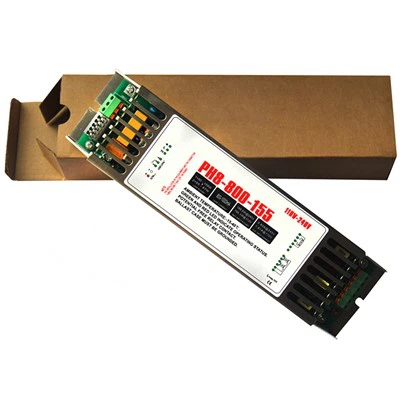
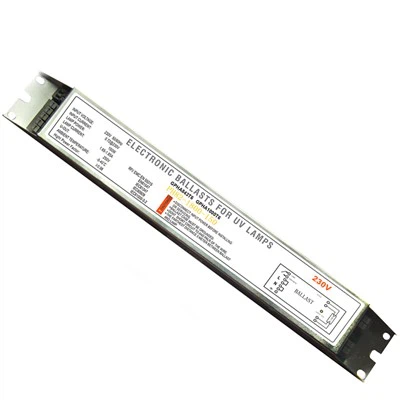
A UV ballast is an essential part of a UV system.The ballast ensures that the UV lamp receives a consistent and stable amount of power, which is necessary for the lamp to function optimally. It helps start the lamp, regulate the current during operation, and protect the lamp from electrical fluctuations. A properly functioning UV ballast is crucial for maintaining the efficiency of the UV water purification system.

How Ballasts Function with UV-C Lamps?
Mercury and Amalgam based UV-C lamps need a high voltage applied between the electrodes to spark the lamp. The uvc light ballast ramps up the input voltage and has an output voltage high enough to spark the lamp. A ballast is needed due to the construction of the lamps, they have negative resistance between the two electrodes. Additionally, a large voltage difference between the electrodes is needed to spark the lamp. The ballast converts the input voltage to the 400 ~ 1,000 volts required to spark the lamp. Once the lamp is sparked and arc is achieved, the ballast limits the voltage to a lower working voltage to keep the lamp illuminated, whilst regulating the power draw of the lamp. Without the ballast, the current through the lamp would increase rapidly until it blew out because of the high voltage and negative resistance. The voltage drop once the lamp sparks is around 300V. This voltage can range up to a couple of thousand volts, depending on the assembly, making the operation voltage of the lamps quite low. In general, the overall current draw of a ballast/bulb system is relatively low.
Within the germicidal ballast there is a combination of resistors, capacitors, inductors, and other printed circuit board level components that dictate the overall output characteristics of the ballast. The ballast converts a sinusoidal AC input, of around 50-60 Hz, and modulate it to a 20-80 kHz square or sine wave pulse output. This eliminates the flicker that was originally associated with gas filled lamps.

What is Applications UV Ballast?
Over the years as technology has advanced, Tidro Products has worked with customers to design and manufacture uvc light ballasts that are used to power Mercury and Amalgam based ultraviolet lamps, with various requirements. UV-C germicidal technology has been proven to be very effective in the HVAC industry for air purification. In the more commercial settings with higher foot traffic, surface disinfection is also a very important focus. New products utilizing germicidal ballasts are being developed every day.
UV-C light is also used for ozone generation, which is used for air and water purification. When ozone is produced by a UV-C lamp, the ozone and the light work in tandem to destroy harmful pathogens.
Another area where you will find uv light ballasts being used is in industrial pipe leak detection devices. Ballasts can also be used in various UV printing and curing applications.
As a result of COVID-19 and other harmful viruses, our ballasts coupled with UV-C technology has become a necessity in a variety of industrial, residential, commercial and healthcare environments.
Starting Types for our Germicidal Ballasts:
Ballasts can be designed with a few different lamp start types to ensure the optimal performance for the uvc bulb type being used.
Instant Start Ballasts
High voltage is applied directly to the electrodes with no heating. This sparks the lamp immediately and the heating of the electrodes is done by the electrical arc within the lamp. This mechanism is the cheapest but also the hardest on the life of the electrodes in the lamp.
Rapid Start Ballasts
Current is applied to the electrodes at the same time as the high voltage. The current heats the electrode but since there isn’t time between the two mechanisms, the electrodes can spark before they are heated sufficiently. This start is an “in-between” for the other two staring mechanisms. It is more cost efficient than the programmed start and not as hard on the electrodes as the instant start. This is the most common start type.
Programmed Start Ballasts
A voltage is applied to the electrode that is too low to start the lamp but preheats the electrodes. After a set amount of time has elapsed, the high sparking voltage is applied. These two steps are pre-programmed into the ballast by the manufacturer based on the components of the ballasts circuitry. This can delay the starting of the lamp by a few seconds but it greatly improves lamp life, especially in applications where there are multiple lamp starts per day.
Certifications

Our Factory


FAQ
Q: Do UV lights need a ballast?
Q: How to test a UV ballast?
2. Test Lamp Ignition. Next, verify that the lamps ignite and remain lit when power is applied to the ballast. ...
3. Measure Lamp Voltage. ...
4. Check Power Supply.
Q: How to tell if a ballast is bad?
Q: What happens if you don't use a ballast?
We're professional UV ballast manufacturers and suppliers in China, specialized in providing high quality customized products. We warmly welcome you to buy or wholesale UV ballast at competitive price from our factory.
Germicidal UV Tube Ballast, Germicidal Lamp Ballast, UV Tube Electronic Ballas UV Driver